 c3b99df788 DDoS was one flat random event. Now each attack has a vector (DNS, NTP, CLDAP, SYN, HTTP), a size from a few Gbps to a multi-terabit monster, a target POP, a duration and an entry point among that city's uplinks. The NOC grows a live attack panel and a toolbox: RTBH (free, instant, but the victim goes dark too), a one-time Flowspec licence that drops known UDP floods at the edge but cannot touch an HTTP flood, the existing scrubbing center, and HackBack 3000, which sometimes ends the attack and often flattens an innocent for a fine. New Vigilante and Collateral Damage badges, Italian translations, and tests for the attack, each tool and old saves. |
||
|---|---|---|
| .claude/skills | ||
| .github/workflows | ||
| docs | ||
| scripts | ||
| site | ||
| tests | ||
| .gitignore | ||
| CHANGELOG.md | ||
| CLAUDE.md | ||
| CONTRIBUTING.md | ||
| LICENSE | ||
| package-lock.json | ||
| package.json | ||
| README.md | ||
Series of Tubes
Build the internet, one tube at a time. A free cartoon browser game about how the internet really works. Play it at seriesoftub.es.
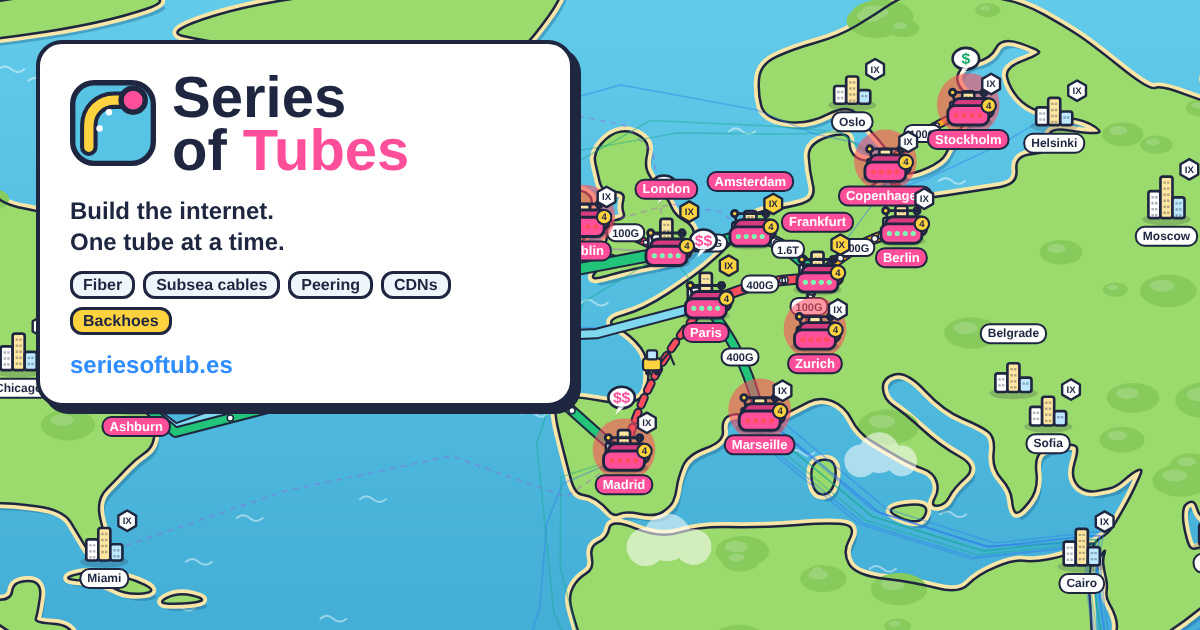
You start with one router in one city and grow into a transit-free Tier 1:
- Customers: home broadband ("eyeballs"), enterprises, hosting, L2VPNs, DDoS protection, high-frequency traders with latency budgets, AI GPU data centers and hyperscaler DCI deals. Some come with very specific requirements.
- Interconnection: IP transit billed on the 95th percentile, internet exchanges with route servers, open/selective/restrictive/paid peering, PNIs, embedded CDN caches, and NNI fabrics for virtual circuits and remote peering.
- Infrastructure: leased waves on around 40 subsea cable systems modelled on real ones, dark fiber (leased or self-built) lit with DWDM and ZR+ optics, router generations that cap your port speeds, and LAGs to bundle ports when one isn't enough.
- Traffic engineering: see exactly what fills each link, tune link metrics and egress preferences, and route traders over the fastest path and backups the scenic way.
- Things break, constantly: backhoes, sharks, fat fingers, route leaks, RPKI mishaps, DDoS, cooling failures, Red Sea and Baltic cable cuts, sanctions and sovereign internet drills.
Every company is a pun. No real company names are used.
Learn how it really works
This game simplifies a lot, and gets some things gloriously wrong on purpose. For the real thing, go to How the Internet Works by Thomas Kjær Aabo (source): an interactive, zoomable map that follows your data from Wi-Fi and copper to undersea fiber, as the internet works today, in 2010 and in 1995, with simple or technical explanations. If you enjoy Series of Tubes, you will learn more from an hour there than from a year of laying cartoon fiber here.
Playing locally
It is a single static page with no build step for development:
open site/index.html # or: npm run serve
Progress is saved in your browser's local storage.
The game speaks English and Italian. It follows your browser's language the first time and remembers the one you pick under Settings or on the title screen.
Development
npm ci
npm test       # headless tests: boot, geography, a year of play, every incident, every panel
npm run build  # writes the deployable site to _site/ with version and date stamped in
npm run i18n:check  # lists text missing from (or stale in) the translations
site/                  everything that is deployed
  index.html           the whole game (HTML, CSS and JS in one file)
  i18n/it.js           Italian translation, loaded only when the game runs in Italian
  images/og-image.png  social preview (1200×630)
  favicon.*, icon-*    favicons, app icons, manifest
  robots.txt, sitemap.xml, llms.txt, 404.html, CNAME
scripts/build.sh       copies site/ to _site/ and stamps __VERSION__ / __BUILD_DATE__
tests/                 node:test + jsdom
.github/workflows/     ci.yml (pushes to main and PRs) and release.yml (Pages deploy)
Translations
English is the source text. Player-facing strings in index.html go through
tr('Unlocks at level {n}.', {n}) (or trn(one, other, n) for plurals); static markup
uses data-i18n, and aria-label/title are translated at boot. Each language is a
site/i18n/<lang>.js file mapping the English text to its translation, plus an entry in
SOT_LANGS (the language loader at the top of the page). Missing entries fall back to
English, so new English text never breaks the game; npm run i18n:check lists what
needs translating, and the tests make sure every translation keeps its {placeholders}
and HTML tags.
Releasing
Only published releases reach seriesoftub.es. Ordinary
pushes to main run CI and nothing else; a version bump is the release button.
- Bump
versioninpackage.json(semver) and rename the changelog's[Unreleased]section to## [<version>] — <date>. Write the bullets for players: the build turns that section into the in-game "What's new" card and into/version.json, which open games poll to offer a reload. - Push or merge to
main.
The Auto-release workflow then runs the tests, tags v<version>, publishes a
GitHub release with that changelog section as notes, and starts the deploy. It
does nothing when the tag already exists, and refuses a version older than the
latest release or one without changelog notes. A version with a pre-release
suffix (1.2.0-beta.1) becomes a pre-release and is not deployed. You can still
publish a release by hand; the deploy runs the same way.
The release workflow checks that the tag matches package.json, runs the tests,
builds, deploys to GitHub Pages and pings IndexNow. It refuses to build when the
CHANGELOG has no ## [<version>] section (rename [Unreleased] first).
Pre-releases never deploy, also not when run by hand, and a version older than
the live one is refused unless you tick allow_older (a deliberate rollback).
To redeploy an existing release, run the workflow manually with its tag.
Hosting setup
GitHub Pages serves the site with Source: GitHub Actions and the custom domain
seriesoftub.es. Releases deploy from tags, so in Settings → Environments →
github-pages → Deployment branches and tags, add a tag rule for v* (by default
only the default branch may deploy). DNS for the apex domain:
seriesoftub.es.        A     185.199.108.153
seriesoftub.es.        A     185.199.109.153
seriesoftub.es.        A     185.199.110.153
seriesoftub.es.        A     185.199.111.153
seriesoftub.es.        AAAA  2606:50c0:8000::153
seriesoftub.es.        AAAA  2606:50c0:8001::153
seriesoftub.es.        AAAA  2606:50c0:8002::153
seriesoftub.es.        AAAA  2606:50c0:8003::153
www.seriesoftub.es.    CNAME fjaeckel.github.io.
stats.seriesoftub.es.  CNAME seocho.jc-ix.net.
Once DNS resolves, enable Enforce HTTPS in the repository's Pages settings.
Analytics
The game uses Ridiculytics: cookieless,
no persistent identifiers, self-hosted at stats.seriesoftub.es. It only reports
from seriesoftub.es itself; local copies, previews and forks stay silent. The
script is pinned to ridiculytics@1.0.1 with an SRI hash.
Besides page views and session length, the game sends a few coarse events, all
under the collector's 50-name cap: game_new, game_continue, play_1m …
play_120m (active, unpaused play time), goal_<id>, level_2–level_4,
game_year_2/3/5, win_tier1 and bankrupt.
The collector must allow the site, e.g. in sites.yaml:
sites:
  - domain: seriesoftub.es
    origins: ["https://seriesoftub.es", "https://www.seriesoftub.es"]
Contributing
Issues and pull requests are welcome. See CONTRIBUTING.md.
License
MIT © 2026 Frederic Jung