 9597d89079 The review of track T2 found these; each has a test in tests/mp-sim-*.
- Built-ins: an arg, array entry or draft that is '__proto__', 'constructor'
or 'prototype' is refused by the envelope check and again by the realm
(free text may still say them). After every realm call the trampoline
checks the realm's built-ins against what they were at load; a realm
whose built-ins changed answers {srvErr, polluted} and is replaced from
the worker's mark like one that timed out. S as one JSON per key is a
null-prototype object, so the epilogue's for…in never reads a prototype.
- A realm that cannot be built again is never used again: rebuild() tries
once more without the packed R, and when that fails too the network is
dropped (NO_REALM), and the engine tells the host (opts.onLost).
- A mark that fails or runs out of time changes nothing: it clears the old
mark first, the realm is built again from its own save, never from an
older mark, and the reply names the mark. A day rebuilds only from its
own attempt's mark.
- A day whose alone or nets is not a list is refused whole (ERR); a throw
in a load or day step answers that call, never ends the worker.
- An exit counts against the session the worker was running (the worker
says so before each job and step), else as before. Workers of their own
are capped (opts.maxOwn, 4): past that a session is given up.
- A worker that exits before it is ready is started again after a pause
that doubles; after 5 in a row every call answers SIM_DOWN.
- The game text is read and compiled once, in createEngine: a src/ that
does not compile throws there, and every worker, also one started after
an exit, runs the game engine.simId names.
- A damaged route memory never breaks a save that loads (routed from
nothing, logged), and only a server network loads (S.mp.sim, Normal).
- Routing memory (UI.rk, UI.rkR) is kept by the in-place restore and
carried in rt (rk), so a reloaded or rolled-back network skips the same
routings as the one that kept going.
- A fresh realm takes over the fx of the one it replaces (the mark's after
a failed call, all of them after a read): badges, windows and toasts
waiting for a page are not lost to a timeout.
- Windows: the stand-in elements answer querySelector from what was
written (a [data-x] marker) and have a working classList, never the
inert proxy that said every window is open. A request's ctx may name the
open window, ctx.win = {k, ui} (mp-sim-acts.js WINDOWS: bstd, routing,
charter, ops, pie), with the view state only the page holds (the
intern's POP, the pie window's tab and POP), checked in the realm. This
is an addition to the contract of design 5.8 that the page (T4) sends.
The stand-in is hidden again after an act.
- xpBuild's via is a TEXT arg (256): a six-span express fits.
- actDone, askDone and pulled carry ms, the worker time of the call;
engine.mem() and engine.has(code, nid) are public; prefs() passes a
realm's err through; after close() every call rejects CLOSED.
- The fake engine fails as the engine does (NO_REALM, ERR, a load without
a save, a day of an unknown session or naming an unloaded network,
GAVE_UP, SIM_DOWN, CLOSED, onLost), its greet says its one-shots once and
never 'told'; a test runs the same edge calls on both.
- SIM_DRAFT is built from DRAFT_TYPES.
|
||
|---|---|---|
| .claude/skills | ||
| .github | ||
| docker | ||
| docs | ||
| scripts | ||
| site | ||
| src | ||
| tests | ||
| .dockerignore | ||
| .gitattributes | ||
| .gitignore | ||
| CHANGELOG.md | ||
| CLAUDE.md | ||
| CODE_OF_CONDUCT.md | ||
| CONTRIBUTING.md | ||
| LICENSE | ||
| package-lock.json | ||
| package.json | ||
| README.md | ||
Series of Tubes
Build the internet, one tube at a time. A free cartoon browser game about how the internet really works. Play it at seriesoftub.es.
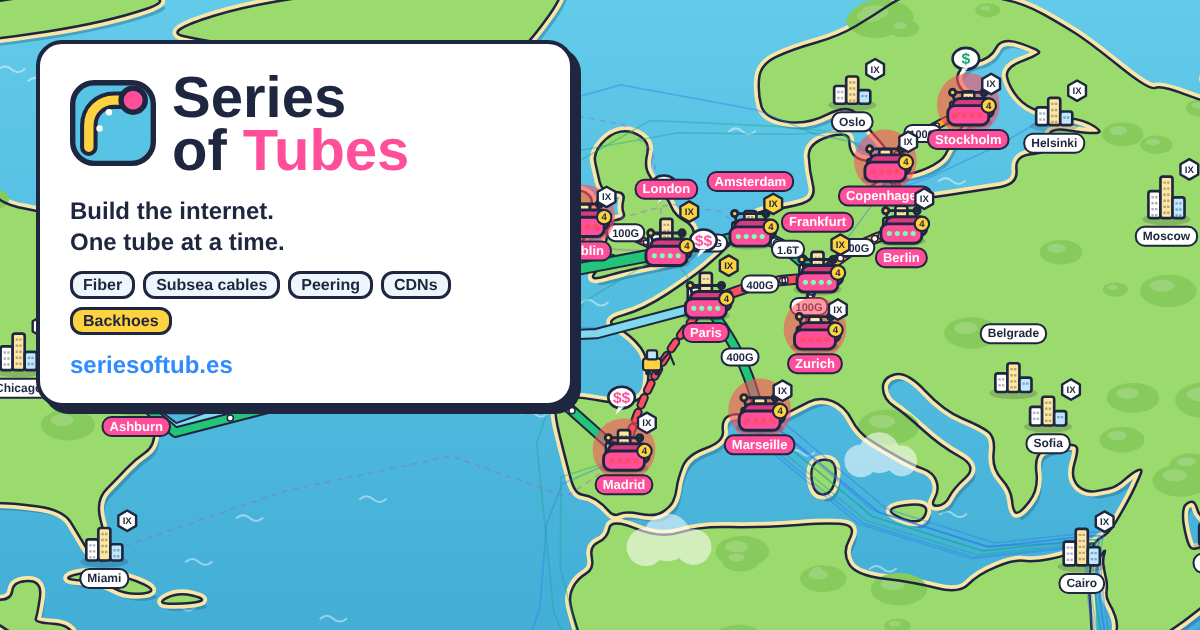
You start with one router in one city and grow into a transit-free Tier 1:
- Customers: home broadband ("eyeballs"), enterprises, hosting, L2VPNs, DDoS protection, high-frequency traders with latency budgets, AI GPU data centers and hyperscaler DCI deals. Some come with very specific requirements.
- Interconnection: IP transit billed on the 95th percentile, internet exchanges with route servers, open/selective/restrictive/paid peering, PNIs, embedded CDN caches, and NNI fabrics for virtual circuits and remote peering.
- Infrastructure: leased waves on around 40 subsea cable systems modelled on real ones, dark fiber (leased or self-built) lit with DWDM and ZR+ optics, router generations that cap your port speeds, and LAGs to bundle ports when one isn't enough.
- Traffic engineering: see exactly what fills each link, tune link metrics and egress preferences, and route traders over the fastest path and backups the scenic way.
- Things break, constantly: backhoes, sharks, fat fingers, route leaks, RPKI mishaps, DDoS, cooling failures, Red Sea and Baltic cable cuts, sanctions and sovereign internet drills.
Every company is a pun. No real company names are used.
Learn how it really works
This game simplifies a lot, and gets some things gloriously wrong on purpose. For the real thing, go to How the Internet Works by Thomas Kjær Aabo (source): an interactive, zoomable map that follows your data from Wi-Fi and copper to undersea fiber, as the internet works today, in 2010 and in 1995, with simple or technical explanations. If you enjoy Series of Tubes, you will learn more from an hour there than from a year of laying cartoon fiber here.
Playing locally
It is a single static page, assembled from the files in src/ by a small Node script:
npm ci
npm run dev                   # http://localhost:8080
Progress is saved in your browser's local storage.
The game speaks English, Italian, Portuguese, French, Spanish and German. It follows your browser's language the first time and remembers the one you pick under Settings or on the title screen.
Development
npm ci
npm run dev    # development server on localhost (--host to share): assembles src/ on every request, reloads on save
npm test       # headless tests: boot, geography, a year of play, every incident, every panel
npm run build  # writes the site for GitHub Pages to _site/, with version and date stamped in
npm run i18n:check  # lists text missing from (or stale in) the translations
npm run mcp    # the game as an MCP server, so an AI client can play and debug it, headless or in your tab (docs/MCP.md)
Community
Come hang out in the Series of Tubes Signal group. Share screenshots of your network, suggest cities, and argue about peering policy with other players. There are fewer backhoes there than in the real thing.
Signal is for chatting. Bugs, feature requests and anything else that should not get lost go into a GitHub issue.
Star history
Contributing
Issues and pull requests are welcome. See CONTRIBUTING.md. Everyone taking part follows the Code of Conduct: be excellent to each other.
License
MIT © 2026 Frederic Jung