 08eb349d87
Some checks are pending
CI / plan (push) Waiting to run
CI / part (push) Blocked by required conditions
CI / build (push) Waiting to run
CI / translations (push) Waiting to run
CI / test (push) Blocked by required conditions
CI / timings (push) Blocked by required conditions
Container image / gate (push) Waiting to run
Container image / test (push) Blocked by required conditions
Container image / publish (push) Blocked by required conditions
Conflicts, file by file:
- CHANGELOG.md: the fork's Unreleased bullets on top; 3.5.0 and 3.4.0 exactly as upstream has them.
- src/i18n/en.js, site/i18n/{de,es,fr,it,pt}.js: merged label by label, sorted; the labels each side dropped stay dropped.
- src/agent/10-domains.js, 30-docs.js, 40-read.js: both sides' enums, state docs and tables (popStd as the build standard, popTiers, ip4, mp).
- src/agent/20-commands.js: the fork's wording on accept and upRouter, upstream's acceptFix, utilityKitAll/New and pt*; theme, session and transfer acts in the local table.
- src/game/60-features/80-new-game.js: ip4, rgen and mp next to popTiers.
- src/game/80-simulation/29-route-core.js, 30-compute.js: the route core takes both SATN and the spill tiers (TT).
- src/game/80-simulation/40-billing.js: upstream's gulfPair and borderShut; linkCut() is built on borderShut, linkDown() keeps express and satellite.
- src/game/80-simulation/50-sanitize.js: PNI bundles up to PNI_LAG_MAX next to the fork's link kinds; popStdSanitize then ptSanitize; mpSanitize then lcSanitize.
- src/game/80-simulation/75-customer-lifecycle.js: clGrow() stops at a type's most (#137) and at an IPv4 block that is not free (#150).
- src/game/90-actions/60-links.js: rmLink keeps the express guard and moves on to the next parallel link (#119).
- src/game/90-actions/85-routing-and-routers.js: rmRouter checks the PNIs on its routers (#323), upRouter keeps own().
- src/game/90-actions/89-game-and-settings.js: the menu keeps the build standard and session tiles and gains Send to another device.
- src/game/93-ui/40-hud-and-panels.js, 70-link-panels.js: offers show both the IPv4 note and Buy and sign; link headers name their cities, the closed-border section reads in dark mode; the express count stays.
- src/game/93-ui/50-city-panel.js: the teleport section and Link to a city.
- src/game/94-dashboard/40-connections.js: upstream's per-table next port size replaces the fork's own 400G guard.
- src/game/94-dashboard/90-noc-window.js, 96-map/95-clicks.js, 99-loop.js: both sides' acts and boot steps.
- src/styles/40-modal.css: the dark-mode tag tokens and the transfer textarea.
- tests/mcp-commands.test.js: both sides' sample args.

Interaction fixes:
- POP standards and the build standard: a POP marked as a kind keeps its kind's routers (ptKind). The build
  standard's router jobs and the intern's model swaps leave it alone; every other target still applies. Both sheets say so.
- Spill tiers: pathMs() fills a path's ground latency and satellite edges too, so a tier's detour costs users its
  latency (it went uncharged before).
- Send to another device: a session network goes by the session's own #mp= link; its save file is called a copy.
- Buy and sign (#241) does not buy for an offer whose IPv4 block does not fit.
- Dark mode: the closed-border title and the renewal ticks use the dark-aware red (upstream's #292 test follows).
- Server-run tables: the new acts classified (pt*, acceptFix and utilityKitAll quote their cost); mp-sim fixtures
  written again with tests/lib/mp-sim-fixtures.js.

Review fixes:
- POP standards: ptSave, ptApply, ptPlan, ptAll and popStdSet find a POP with own(), so 'toString' is no POP (also
  decomToggle, decomGo, dkStay).
- Server-run envelope: an arg value that names anything on Object.prototype is refused, in args, drafts and
  ctx.win.ui.
- Decommissioning a POP drops its POP-standard mark, so live state stays what a reload makes of it (the T2 gate
  refused later pt* acts).
- acceptFix, ptApply, ptAll and utilityKitAll take a quote within 1% (quoteNear), like utilityKit and bstdApply:
  router prices drift daily.
- The transfer paste box reads in dark mode (--text, as input.t).
- A session's #mp= link pasted under From another device opens it (saved, then loaded again with it), in MP builds.
- The express and satellite circuit panels name their cities as links (#196); a circuit shows the closed-border
  section (#329).
- CHANGELOG: the fork's 400G connections bullet goes (3.5.0 ships it); bullets for POP kinds, the session link and Buy
  and sign's IPv4 check.
|
||
|---|---|---|
| .claude/skills | ||
| .github | ||
| docker | ||
| docs | ||
| scripts | ||
| site | ||
| src | ||
| tests | ||
| .dockerignore | ||
| .gitattributes | ||
| .gitignore | ||
| CHANGELOG.md | ||
| CLAUDE.md | ||
| CODE_OF_CONDUCT.md | ||
| CONTRIBUTING.md | ||
| LICENSE | ||
| package-lock.json | ||
| package.json | ||
| README.md | ||
Series of Tubes
Build the internet, one tube at a time. A free cartoon browser game about how the internet really works. Play it at seriesoftub.es.
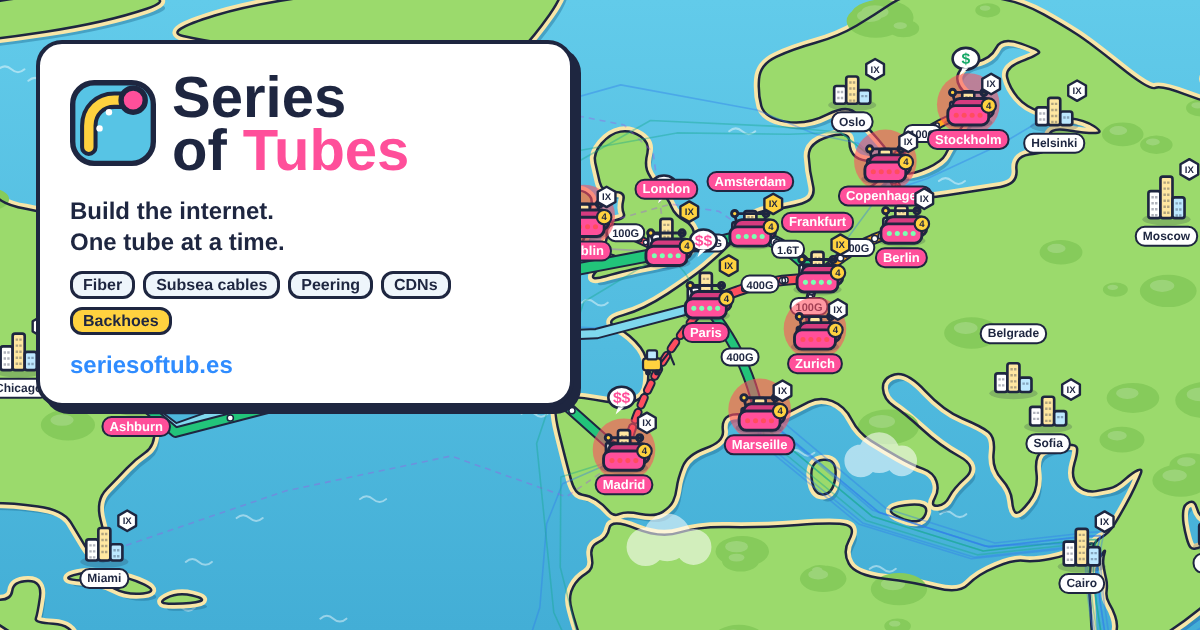
You start with one router in one city and grow into a transit-free Tier 1:
- Customers: home broadband ("eyeballs"), enterprises, hosting, L2VPNs, DDoS protection, high-frequency traders with latency budgets, AI GPU data centers and hyperscaler DCI deals. Some come with very specific requirements.
- Interconnection: IP transit billed on the 95th percentile, internet exchanges with route servers, open/selective/restrictive/paid peering, PNIs, embedded CDN caches, and NNI fabrics for virtual circuits and remote peering.
- Infrastructure: leased waves on around 40 subsea cable systems modelled on real ones, dark fiber (leased or self-built) lit with DWDM and ZR+ optics, router generations that cap your port speeds, and LAGs to bundle ports when one isn't enough.
- Traffic engineering: see exactly what fills each link, tune link metrics and egress preferences, and route traders over the fastest path and backups the scenic way.
- Things break, constantly: backhoes, sharks, fat fingers, route leaks, RPKI mishaps, DDoS, cooling failures, Red Sea and Baltic cable cuts, sanctions and sovereign internet drills.
Every company is a pun. No real company names are used.
Learn how it really works
This game simplifies a lot, and gets some things gloriously wrong on purpose. For the real thing, go to How the Internet Works by Thomas Kjær Aabo (source): an interactive, zoomable map that follows your data from Wi-Fi and copper to undersea fiber, as the internet works today, in 2010 and in 1995, with simple or technical explanations. If you enjoy Series of Tubes, you will learn more from an hour there than from a year of laying cartoon fiber here.
Playing locally
It is a single static page, assembled from the files in src/ by a small Node script:
npm ci
npm run dev                   # http://localhost:8080
Progress is saved in your browser's local storage.
The game speaks English, Italian, Portuguese, French, Spanish and German. It follows your browser's language the first time and remembers the one you pick under Settings or on the title screen.
Development
npm ci
npm run dev    # development server on localhost (--host to share): assembles src/ on every request, reloads on save
npm test       # headless tests: boot, geography, a year of play, every incident, every panel
npm run build  # writes the site for GitHub Pages to _site/, with version and date stamped in
npm run i18n:check  # lists text missing from (or stale in) the translations
npm run mcp    # the game as an MCP server, so an AI client can play and debug it, headless or in your tab (docs/MCP.md)
Community
Come hang out in the Series of Tubes Signal group. Share screenshots of your network, suggest cities, and argue about peering policy with other players. There are fewer backhoes there than in the real thing.
Signal is for chatting. Bugs, feature requests and anything else that should not get lost go into a GitHub issue.
Star history
Contributing
Issues and pull requests are welcome. See CONTRIBUTING.md. Everyone taking part follows the Code of Conduct: be excellent to each other.
License
MIT © 2026 Frederic Jung